Tutorial 30 of 48
Aluette: signals, spoiled tricks and mordienne
Intermediate 7 min
Play Aluette (la Vache) with 48 Spanish-suited cards — the luettes on top, spoiled tricks, the race for the most tricks and partner signals.
Aluette, also called la Vache (“the cow”, after the picture on the 2 of Cups), is an old trick-taking game from the Vendée and the coast of Brittany. Two teams play, but every player counts their own tricks — and partners may help each other with secret signs.
Setting up a table
- Under Trick-taking games choose Aluette.
- Aluette always has four players: seats 1 and 3 play against seats 2 and 4.
- Pick Against the computer, Pass the device (friends on this device) or Online with friends (invitation code) and press Deal the cards.
Everyone gets nine cards; the other twelve stay out and nobody sees them.
The order of the cards
Suits do not matter and anything may be played. The cards rank from high to low:
- Monsieur (3 of Coins), Madame (3 of Cups), le Borgne (2 of Coins), la Vache (2 of Cups) — the luettes.
- Grand-neuf (9 of Cups), Petit-neuf (9 of Coins), Deux de chêne (2 of Batons), Deux d’écrit (2 of Swords) — the doubles.
- The four Aces, Kings, Knights and Jacks, the Nines of Swords and Batons, then Eights, Sevens, Sixes, Fives, Fours and the Threes of Swords and Batons.
The eight top cards carry their nickname on the card and in their name for screen readers, for example “3 of Coins (Monsieur)”. Cards in the same group are equal — two Kings are worth exactly the same.
Tricks and spoiled tricks
The player on the dealer’s left leads. The highest card wins the trick and its player leads next. If the highest cards are equal — two Aces, for example — the trick is spoiled: nobody takes it and the same player leads again. The status shows Last trick: spoiled, nobody takes it.
Playing last is a big advantage: you see everything before you decide. A common pattern from the pagat.com description: the first two players play low, the third plays high enough to stop the fourth, and the fourth beats as cheaply as possible — or spoils the trick with an equal card to keep the lead in their team.
Who wins the deal
Partners do not add their tricks. The individual player with the most tricks wins one point for the team; if several have the same number, the one who reached it first wins. The seat list shows Tricks for everyone.
Mordienne: a player who took no trick before and then wins the last tricks in a row (none of them spoiled) scores two points. A match is five deals.
Signals
At the start of each deal there is a short signal round, and you may also signal on your turn. Choose a sign under Signal to your partner and press Make the sign, then Done signalling:
- Monsieur — eyes raised; Madame — head tilted; le Borgne — a wink; la Vache — a pout.
- Grand-neuf — thumb; Petit-neuf — little finger; Deux de chêne — index finger; Deux d’écrit — miming writing.
- An Ace — mouth opened; a bad hand — shoulders raised; mordienne — lip bitten.
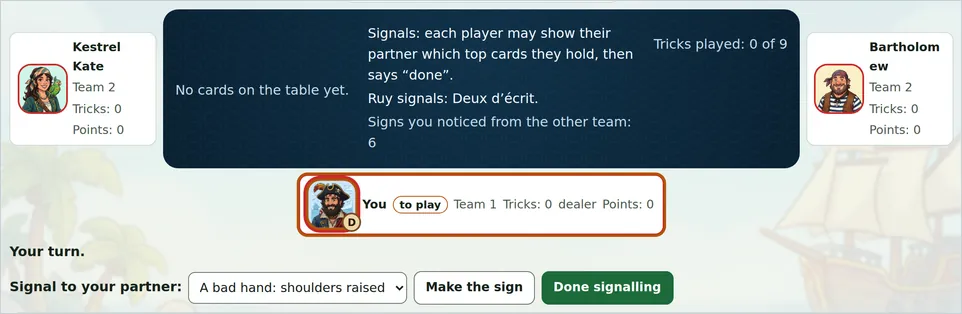
At a real table the grimaces are made in secret and the opponents try to catch them. In Playcards a sign is a move: you can only signal cards you really hold, your partner sees which sign it was, and the other team only learns that you made a sign (Signs you noticed from the other team). The strong computer players use their partner’s signs when they think ahead.
House rules
Under House rules: Match — a fixed number of deals or first team to a number of points (Deals or points: 3, 5, 7 or 10), Mordienne scores two points, Signals to the partner (allowed or off) and Chant: the dealer and the player on the left receive six of the leftover cards each and then put six cards away, one at a time.
Ready to try it?