Tutorial 37 of 48
Durak: attack, defend and do not be the fool
Intermediate 7 min
Play Durak, Russia's favourite card game — attack and defend with trumps, throw in matching ranks, pick up when you must and avoid being the last one with cards.
Durak (Дурак, “fool”) is the most popular card game in Russia. Nobody wins Durak — there is only a loser: the last player still holding cards is the durak, the fool. Playcards plays the best-known form, Podkidnoy Durak (“fool with throwing in”).
Setting up a table
- Under Shedding games choose Durak.
- Set the Number of players (2 to 6) and press Deal the cards.
Everyone gets six cards from a pack of 36 (6 up to Ace). The next card is turned face up: its suit is trumps. It lies under the talon and is drawn as the very last card. In the first deal the player with the lowest trump shows it and attacks first.
Attacking
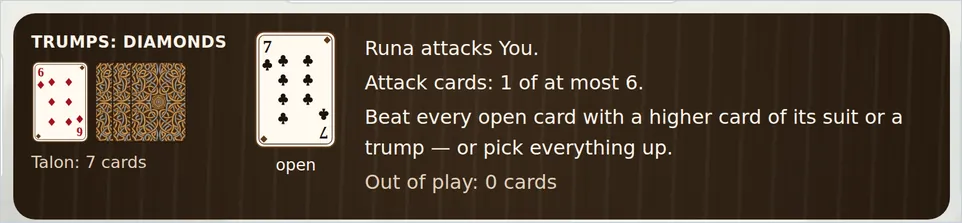
When it is your turn to attack, click any card: it goes on the table in front of the defender — the player on your left. The status box says who attacks whom, for example Computer 2 attacks Computer 3.
Defending
When you defend, beat each open card on the table:
- with a higher card of the same suit, or
- with any trump — a trump can only be beaten by a higher trump.
You never have to follow suit: you may trump a plain card even if you hold its suit. Click the card you want to beat with. If it could beat several open cards, Playcards asks which one (Beat …). If you cannot or do not want to beat a card, press Pick up the cards.
Throwing in
After every beaten card the attacker — and then the other players, clockwise from the defender's left — may add more cards, but only of ranks already on the table. If a 7 was beaten with a 10, any 7 or 10 may follow. Click a matching card to add it, or press Done — no more cards.
There are limits: at most six attack cards per bout, and never more than the defender held when the bout began. The status box shows Attack cards: 3 of at most 6.
Beaten off or picked up
- If the defender beats everything and nobody adds more, the cards go out of play and the defender attacks next.
- If the defender picks up, the attackers may still give matching cards (Add nothing more ends that) and the defender takes everything. Picking up costs the turn: the next player on the left attacks.
After each bout everyone refills to six cards — the attacker first, the defender last. Cards that were picked up are known to everybody; good players remember them.
The end of the deal
When the talon is used up, nobody refills any more. A player without cards is out — safe. The last player still holding cards is the durak and gets a fool point. If the last cards all go in the same bout, there is no fool. A match is five deals; the fewest fool points win.
In the next deal the fool deals, and the player on the dealer's left attacks first.
House rules
Under House rules you can choose:
- Cards in the pack: 36 or 52.
- Who may add cards: every other player, or only the defender's two neighbours (common with five or six players).
- Transfer (Perevodnoy Durak): before you beat anything, add a card of the same rank as the attack to pass the whole attack on to the next player — if that player has enough cards.
- Swap the lowest trump: whoever was dealt or drew the lowest trump may exchange it for the face-up trump while the talon lasts — on your turn press Swap your lowest trump for the face-up ….
- First bout of a deal: at most five cards.
- From the second deal: the dealer's left-hand player attacks, or the fool is taught — the fool is attacked first.
- Deals in a match.
Tips
- Attack with low plain cards and pairs; keep trumps for defence.
- While the talon is long, picking up a few low cards is often better than spending a high trump.
- In the endgame count the trumps that are still out — the move list shows every card that was picked up.
The rules follow pagat.com's Podkidnoy Durak and Perevodnoy Durak by John McLeod.
Ready to try it?