Tutorial 28 of 48
Truc: bets, bluffs and the Envit
Intermediate 8 min
Play Valencian Truc against the computer — three cards, Truc, Retruc, Quatre val and Joc fora, the Envit with Torna and Falta, and ties called parda.
Truc is the bluffing game of Valencia and Catalonia: three cards each, up to three tricks — and bets that the other side can accept or turn down. Playcards plays the Valencian rules as published by Barajamos and Truc Online by default; the Catalan game from pagat.com is a house rule. The text below is our own summary.

Start a game
- Under Choose a game pick Truc (bluffing games).
- Choose 2 players (you against one) or 4 (two teams, your partner sits opposite) and Against the computer.
- Press Deal the cards.
The cards
Valencian Truc uses 22 Spanish cards: the 3 to 7 of every suit plus the Aces of Swords and Batons. From high to low:
- Ace of Swords, 2. Ace of Batons, 3. 7 of Swords, 4. 7 of Coins, 5. the Threes, 6. 7 of Cups and 7 of Batons, 7. the Sixes, 8. the Fives, 9. the Fours.
Cards on the same step are equal. You never have to follow suit — play any card.
Tricks and parda
The highest card wins the trick. If the two sides tie at the top, the trick is parda (a tie); if partners tie, the trick is theirs. Two tricks win the hand:
- one trick won and one parda: the side that won its trick takes the hand;
- one each: the third trick decides — a parda there goes to the winner of the first trick;
- three pardas: the side of the first player (mano, marked on the seat) wins.
The list Tricks of this hand on the table shows every result.
Truc: raise the stakes
A hand is worth 1. At your turn press Call Truc (2). The other side answers Accept, Reject or raises: Retruc (3), Quatre val (4), Joc fora (the whole game). Raising accepts the bet before it. After a bet is accepted, only the side that accepted may raise next.
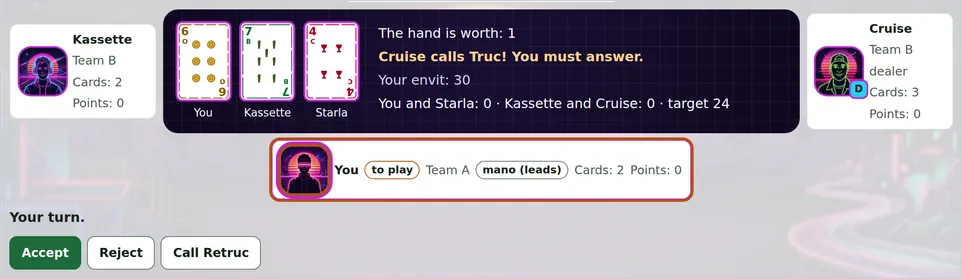
A rejected bet ends the hand: the side that asked scores the value before the bet — 1 for a rejected Truc, 2 for a rejected Retruc. Example: you call Truc, they answer Retruc, you reject — they score 2.
Give up the hand at your turn concedes the hand at its current value. Bluffing is the heart of the game: a confident Truc with weak cards often makes the others give up.
Envit: a bet on your cards
Your envit is 20 plus the numbers of your two best cards of one suit; without two of a suit it is your highest single number. The table shows Your envit. Examples: 7 and 6 of Coins with a 3 of Cups = 33, the best possible; 5 and 4 of Swords with a 7 of Batons = 29; Ace, 7 and 3 of Swords = 30 (the two highest count); no two of a suit with a 6 as the best = 6.
In the first trick, before you play your card and before anyone called Truc, you may Call Envit (2) or Call Falta. The answer: Accept, Reject, Torna (4) or Falta. The Falta is worth what the leading side lacks to the target; while both sides are below half the target it wins the game. A rejected Envit gives the asking side 1, 2 or 4.
The best envit at the table wins — on a tie the player earlier from mano. It is counted at the end of the hand, before the Truc, and only the winning cards are shown. Example: the score is 15 to 8 with target 24; a Falta is worth 24 − 15 = 9.
If the Envit reaches the target, the game is over and the Truc of that hand no longer counts.
House rules
- Cards and ranking: Valencian (22 cards, Aces of Swords and Batons on top) or Catalan (40 cards, 3 2 1 highest) — in the Catalan game suits never matter.
- Envit bets (Envit, Torna, Falta) on or off (the Catalan game on pagat.com plays without them).
- Highest Truc bet: Joc fora (the whole game) or Retruc (3 points).
- Game to: 12, 18, 24 or 30.
What Playcards leaves out
Real tables signal cards to their partners with faces (a wink for a Three …) and talk freely; Playcards has no signals or chat. When you give up, your whole side gives up (some tables let the partner play on), and bets are made at your own turn only.
Ready to try it?